Regularity vs Irregularity in Art: Motion and Beauty in a Student Experiment
- GIOVANNI PERILLO
- Mar 28
- 2 min read

Updated: May 12
This project is part of the SMartS project, which promotes inquiry-based and interdisciplinary learning in schools (SMArtE method) and contributes to international research in art education. The inquiry-based approach used in this project (and in all projects in SMartS) can be widely applied in STEAM education, including in contexts such as the United States, to teach art, geometry, mathematics and technology in an interdisciplinary way. It bridges artistic creativity, mathematical reasoning, scientific thinking and critical analysis.
INTRODUCTION
This project explores the relationship between regularity, irregularity and the perception of beauty in moving images. Developed within the SMArtE method (Scientific Method in Art Education), the experiment applies an inquiry-based approach to investigate how structured and unstructured motion influences aesthetic judgment.
The experimental workshop was conducted with 13-year-old students from the “Poli” School in Molfetta (Italy) and the with “Theodore Roosevelt” School in Weehawken (New Jersey, USA), allowing students to engage in a cross-cultural investigation of visual perception and movement. The project was also developed with Lorenza Minervini (Literature teacher at the Poli School) and with Francesca Amato and Donna Jimmerson (Vice Principal and Science teacher at the Theodore Roosevelt School).
RESEARCH QUESTION
How do regular and irregular patterns influence the perception of beauty?
Does structured movement appear more aesthetically pleasing than irregular motion?
METHOD
Students created and observed sequences of movements based on both regular and irregular patterns. In some cases, movements were coordinated and structured, while in others they were random and independent.
The experiment involved observing choreographic compositions and visual patterns, analyzing how different levels of order and complexity influenced perception.

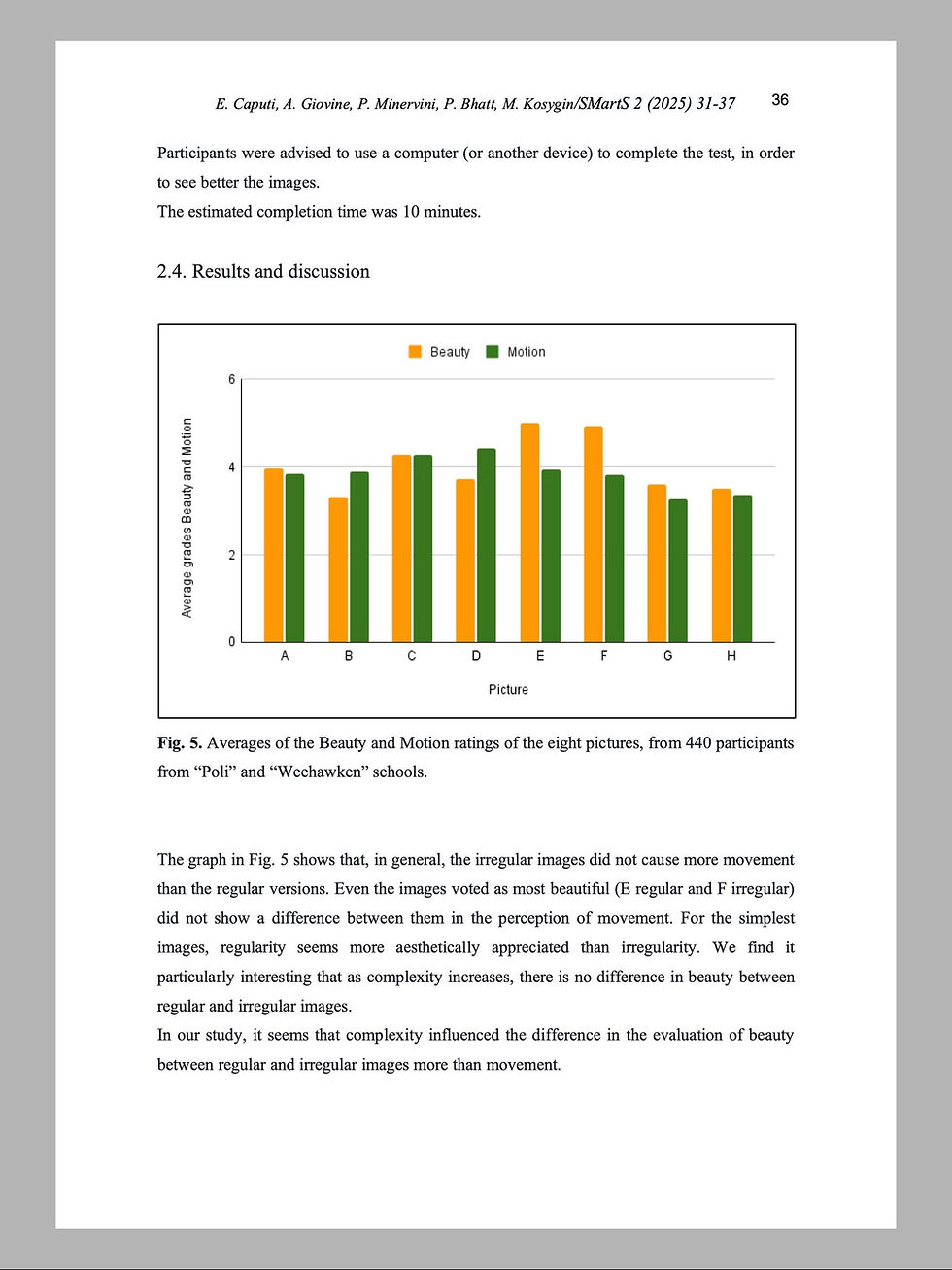
RESULTS
The results showed that both regularity and irregularity can influence aesthetic perception in different ways. Structured and coordinated movements were often perceived as clear and harmonious, while irregular patterns were sometimes seen as more dynamic and engaging.
Students’ responses varied depending on context and interpretation, highlighting the subjective nature of aesthetic judgment.
DISCUSSION
The findings suggest that beauty in visual and performative art is not determined solely by order or symmetry, but emerges from the interaction between structure, complexity and perception.
The comparison between regular and irregular motion allowed students to reflect on how patterns, rhythm and variation shape aesthetic experience.
CONCLUSION
This project demonstrates how the scientific method can be applied to art education, enabling students to explore fundamental concepts such as order, complexity and movement through experimentation.
By combining artistic practice with analytical observation, students develop both creative and critical skills in an interdisciplinary learning environment.
This project contributes to the development of contemporary approaches to inquiry-based and research-based learning in international education.
Explore more student projects based on the scientific method in art education (click on the link):
Regularity vs Irregularity in Dance: Movement and Beauty in Art Education
The Beauty of Tessellations: Art and Mathematics in a Student Experiment
Camouflage and Visual Perception: A Student Experiment in Art Education
Why Do Hand Gestures Have Those Shapes? A Student Art and Perception Experiment
Aesthetic Judgment and Visual Complexity: A Student Art Education Experiment


Comments